Olive knot is a bacterial infection caused by the bacterium Pseudomonas savastanoi, which is endemic to Olea europaea and, like many bacteria, is spread by water.
It is a disease that plants contract through wounds caused by pruning, by harvesting the drupes when the plant is wet or damp, and by various atmospheric events such as hail, late frosts, snow load breakage, and even wind when it causes branch breakage in wet conditions.
Since it is not possible to intervene with systemic products against bacteria, prevention is essential. This is achieved through good agronomic practices and copper treatments at a dose of 1%.
In the case of olive knot, good agronomic practices consist of absolutely avoiding pruning olive trees or harvesting drupes when the plants are wet or damp, or in the hours immediately preceding a forecasted weather event.
Copper treatments can be both preventive and post-damage, as the caustic power of copper, when applied in the hours immediately following the occurrence of damage, reduces the bacterial population living on the plant and hardens the exposed tissues, decreasing the chances of infection.
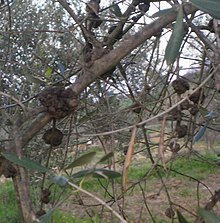
The bacterium induces the formation of tubercles, which later become its receptacle.
The young tubercles appear as small, silvery-green, regular-surfaced protuberances on the branches. As they mature, they turn brown and increase in size, reaching up to 2 or 3 cm in diameter and taking on less homogeneous and more irregular shapes. Inside, they appear spongy, with large cavities and a light color.
Normally, the parts of the plant downstream from these formations tend to defoliate, lignify abnormally, drastically reducing the induction of flowers from axillary buds and thus fruiting.
The parts of the plant in these conditions must necessarily be removed by pruning, allowing the plant itself to rebuild a less infected canopy in the following season.
However, remember that an olive tree infected with olive knot will never recover. Nevertheless, each variety coexists more or less well with the disease and manifests it more or less intensely.
For example, the Leccino variety almost does not show symptoms, while the Frantoio variety shows them clearly.
We must also dispel the myth that it is necessary to burn the pruning residues of plants infected with olive knot and that they should not be chipped to prevent the spread of the infection, because, as already mentioned, the bacterium is endemic to the olive tree throughout the Mediterranean basin, meaning it lives permanently on the bark of the plants. Burning pruning residues is therefore a completely useless practice. Instead, one should refrain from pruning and harvesting with wet or damp plants and in the 24/48 hours before forecasted weather events.
Antonio Genovesi Farm
via San Francesco, Boville Ernica (FR) Italy
email info@agricolagenovesi.it
mob. +39 347 6941166
VAT no.: 03135300600
The Blog - Evo, Olives, Pruning, Tasting
everything you need to know about the Evo, and even more
Olive tree scab. Causes and common misconceptions.
Olive tree scab. Causes and common misconceptions.
2023-01-19 19:49
2023-01-19 19:49
Array() no author 92913
olivo, prevenzione, patologie, rogna, olea-europea, trattamenti, sintomatologia, buone-pratiche-agronomiche, batterio, pseudomonas-savastanoi,
Antonio Genovesi Farm
via San Francesco, Boville Ernica (FR) Italy
email info@agricolagenovesi.it
mob. +39 347 6941166
VAT No.: 03135300600