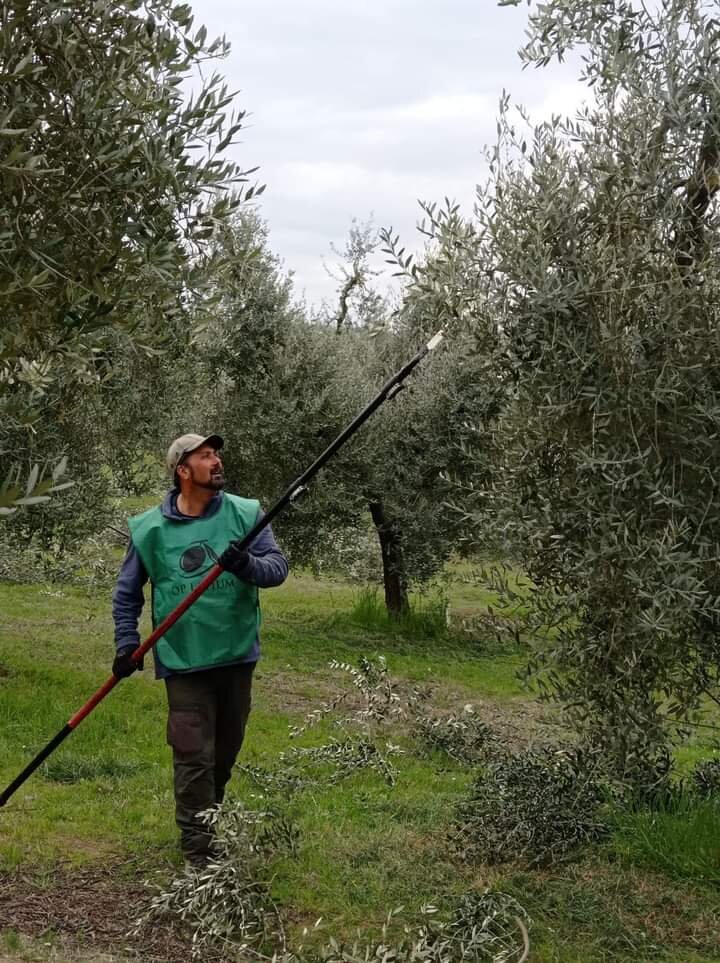
Pruning the olive tree should be done to renew unproductive branches, remove dry or damaged branches, encourage the penetration of light and air, support vegetative growth, and contain the size of the tree. Essentially, pruning the olive tree is the relational dialogue between the olive grower and the nature that the olive tree represents. It is not for the benefit of the olive tree, but for the benefit of humans to gain an economic advantage.
Furthermore, pruning should help prevent premature vegetative aging of the tree, decrease production alternation, and minimize the risk of diseases caused by pests.
Pruning should preferably be carried out during the winter, up until budding. Pruning interventions during harvest should be avoided, especially in light of recent climate changes that have seen autumn temperatures rise and the harvest period move earlier to the beginning of autumn. Interventions at the end of autumn are possible where the likely premature vegetative response does not pose a risk of cold damage.
There is a need to concentrate pruning operations in the period when the plants have stored their reserves up to the period immediately preceding vegetative recovery, when the reverse process begins. Pruning interventions carried out earlier or later than the optimal period cause unnecessary waste of resources and vegetative responses that are partial and different from expectations.At the same time, many olive growers do not consider summer pruning or green pruning. In cases of excessive adventitious vegetation (shoots and suckers), it is preferable and is in any case complementary to winter-spring pruning because it anticipates the removal of woody structures that are useless for production, hinder harvesting, and would otherwise increase their mass in winter, consuming nutrients at the expense of others.
Shoots should be completely removed, while selective interventions are appropriate for suckers, eliminating the most vigorous and upright ones with a perpendicular insertion point on the back of the branches and preserving the smaller and weaker ones, with a lateral or ventral insertion point. This careful selection must be carried out scrupulously by the pruner in order to ensure regular functionality of the dorsal vascular system, through the remaining leaves, and to renew the productive structures which in the olive tree, except in some specific varieties, are always semi-pendulous and sub-horizontal structures.
Antonio Genovesi Farm
via San Francesco, Boville Ernica (FR) Italy
email info@agricolagenovesi.it
mob. +39 347 6941166
VAT no.: 03135300600

The Blog - Evo, Olives, Pruning, Tasting
everything you need to know about the Evo, and even more
Pruning. A dialogue between nature and man.
Pruning. A dialogue between nature and man.
2023-01-02 16:36
2023-01-02 16:36
Array() no author 92913
potatura, olio-extravergine-di-oliva, dialogo, produzione, principi, salute, sostenibilita, vaso-policonico-semplificato, prevenzione, benessere, servizi-agricoltura, potatore-certificato, preparazione,
Antonio Genovesi Farm
via San Francesco, Boville Ernica (FR) Italy
email info@agricolagenovesi.it
mob. +39 347 6941166
VAT No.: 03135300600