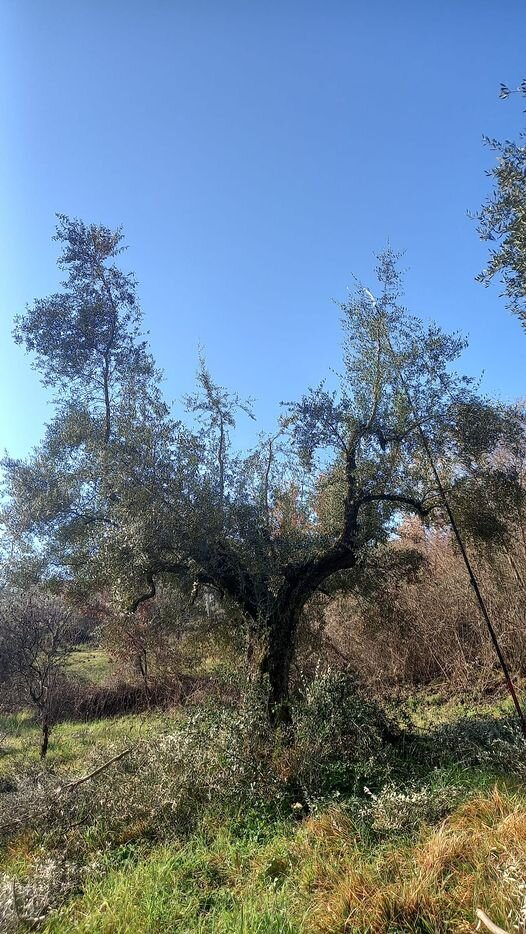
In the pruning of centuries-old olive trees, it is necessary and essential to carefully observe the shape and geometry of the trunk.
The basic rules of simplified polyconic vase pruning tell us that pruning should be carried out from top to bottom and from the inside out.
In the case of centuries-old olive trees, these rules should only be applied after carefully observing the geometry of the trunk in order to identify the cords that feed the main branches and the height of the crown.
The cords are the set of vascular bundles that feed one or more branches, that is, they connect the roots to the canopy. They usually have a twisted or ribbed appearance and a very rough bark surface. On each of them, the bark scales change their inclination slightly, making them easier to identify. Usually, the line of contact between two adjacent cords is concave towards the center of the trunk.
Identifying the cords is fundamental because it allows us to understand whether a cord feeds only one or several main branches. It is not uncommon for centuries-old trees to have many more than the three or four branches that we pruners are used to dealing with in young olive groves, and this could put us in difficulty during pruning.
It often happens, in the reform of poorly managed young olive groves, to prune olive trees with five or six branches which, due to various dichotomies, can even reach ten. In these cases, to reorganize the canopy into a simplified polyconic vase, the pruner decides to eliminate some branches and dichotomies.
In the pruning of centuries-old olive trees, this is not always possible due to the marked sectorization of the trunk into cords, so the brutal elimination of a branch would trigger decay phenomena in the corresponding cord, with the consequent compromise of an important portion of the plant.
Therefore, before removing a branch, for reasons of space, interference, geometry, self-shading, etc., it is necessary to carefully check whether the reference cord feeds only that branch or also other sectors of the canopy.
If a cord corresponds to only one branch, it is advisable to avoid cutting the branch so as not to risk the decay of the cord.
If a cord corresponds to two main branches, then it is possible to consider, if necessary, cutting one of the two branches, because the cord will remain vital to feed the surviving branch.
The other element to consider is the height of the olive tree. Usually, centuries-old trees are trained quite high because in ancient times the land of olive groves was used for associated crops and the planting distances were quite wide. It is not difficult to find centuries-old trees that exceed eight meters in height with trunks that can reach two meters in height, with a canopy height and diameter that can also exceed eight meters.
In these cases, it is essential to respect the conical gradient when making return cuts on the main branches. The gradient consists not only in respecting the proportion between the diameters of the secondary branches and the main branch at the point of insertion, but also in maintaining the same proportion when choosing, with a return cut, a replacement top of suitable diameter to act as a tie rod for the entire branch.
In cases where there are no suitable replacement tops, the possibility of postponing the lowering intervention to the next pruning season should be considered, and therefore only a partial reform should be carried out at the moment, and in the pruning interventions of the following years, a suitable replacement top should be chosen.
Antonio Genovesi Farm
via San Francesco, Boville Ernica (FR) Italy
email info@agricolagenovesi.it
mob. +39 347 6941166
VAT no.: 03135300600

The Blog - Evo, Olives, Pruning, Tasting
everything you need to know about the Evo, and even more
Dialogue between patriarchs and men
Dialogue between patriarchs and men
2023-02-20 19:57
2023-02-20 19:57
Array() no author 92913
potatura, dialogo, potatore, vaso-policonico-semplificato, corde, patriarca, olivo-centenario, rispetto,
Antonio Genovesi Farm
via San Francesco, Boville Ernica (FR) Italy
email info@agricolagenovesi.it
mob. +39 347 6941166
VAT No.: 03135300600