Last Saturday marked the conclusion of the series of three meetings dedicated to olive growing organized by the Lago di Posta Fibreno Nature Reserve, for which we were invited to collaborate.
The three days were part of a program full of events to celebrate the 40th anniversary of the establishment of the Reserve.
We tried to tell the story of the bond between humans and olive cultivation and
between oil and cuisine, spanning over 4000 years of history, the connection with religions and Mediterranean societies, the economy of the Roman Empire, the abandonment during the Middle Ages, the rebirth of the countryside during the city-state period, the new abandonment of the 20th century following industrialization, and the rediscovery of the last two decades.
Yes, rediscovery!
More and more people are deciding to return to live their lives in the countryside. And here, between Ciociaria and Terra di Lavoro, the traveling companion is the olive tree.
A difficult crop, often for subsistence, not very profitable, which fills the days with hard work on steep slopes, where our ancestors understood that the olive tree, thanks to its hardiness, would live and produce good oils, leaving the possibility to cultivate the fields below with cereals and vegetables.
A choice that many today regret due to the different social habits developed in the 20th century, which push for a more hectic life, leaving no space or time for the care of our landscape and countryside. Dragging us into the mass consumption of products that, although certainly safe and healthy, have little to do with a diet that is also tasty, delicious, and more connected to local traditions.
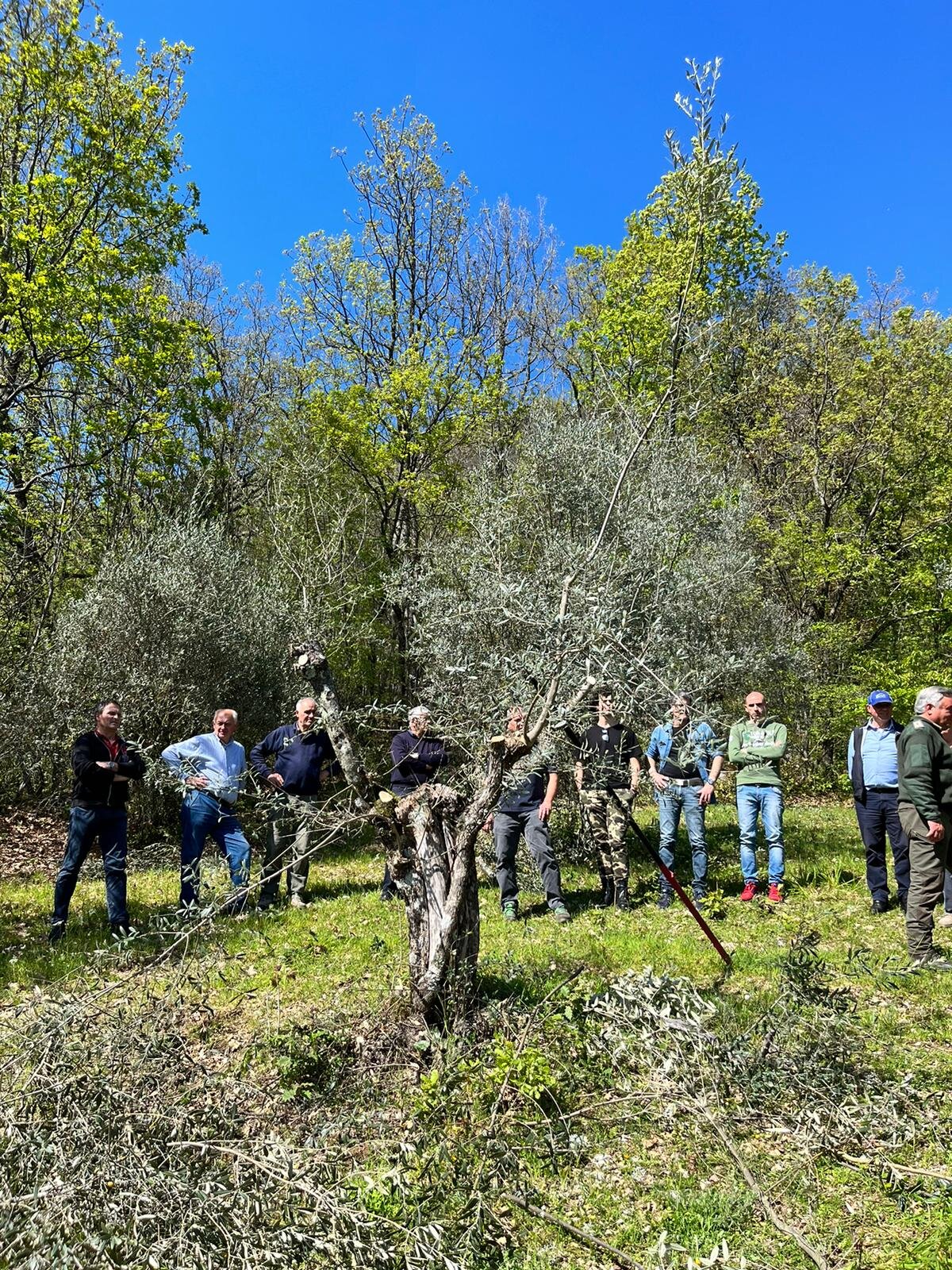
Agronomic and pruning techniques were at the center of two days. There was discussion about the difficulty of recovering historic olive groves and their regular maintenance, and about the equipment that technology offers us today. Above all, we tried to understand that the pruner today is, first of all, a person of culture, with knowledge of olive physiology and trained for the correct use of equipment, who works knowingly and safely from the ground. And not a person who prunes by cutting without a precise project to carry out, endangering their own life by working with ladders. Recent studies, in fact, have affirmed and consolidated theories on olive pruning already studied by agronomists in the 1920s, confirming the polyconic vase technique as the best to apply for the respect it shows towards the physiological needs of the plant and the economic needs of the olive grower, even the hobbyist.
On the third day, instead, the focus was on extra virgin olive oils and the perception of their quality, which in recent decades has undergone a great and positive evolution. Olive oil, once considered simply a condiment and fat for cooking and preserving food, is now considered one of the fundamental pillars of Italian cuisine and the Mediterranean diet, an indispensable ingredient in many dishes, now at the center of studies that increasingly confirm its nutraceutical properties.
But to have good oil on our tables every day, it is not enough to have a tidy olive grove and healthy olive trees.
It is essential to understand that you must bring healthy, fresh fruit to the mill as quickly as possible, to modern mills, and finally know how to properly store the oil at home, away from light, heat, cold, and air.
Recognizing a good extra virgin olive oil means remembering that it is a fruit juice, which as such must necessarily have all the characteristics of the fruit from which it is squeezed, that is: recalling the aroma and taste of the fruit, having a smell or fruitiness that is green, meaning reminiscent of freshly cut grass, and a certain degree of bitterness and pungency, more or less intensely perceived on the palate.
We want to thank the Reserve Management, in the person of Dr. Antonio Lecce, and all the staff, for involving us in these initiatives, and the more than one hundred people from the provinces of Frosinone, Latina, Rome, and Caserta who attended, bringing with them their experiences and giving us the opportunity in the discussion to clarify some aspects of modern olive growing, also dispelling some habits born from misinterpreted and not entirely correct stories and traditions.
Antonio Genovesi Farm
via San Francesco, Boville Ernica (FR) Italy
email info@agricolagenovesi.it
mob. +39 347 6941166
VAT no.: 03135300600

The Blog - Evo, Olives, Pruning, Tasting
everything you need to know about the Evo, and even more
A beautiful adventure in the Posta Fibreno Lake Nature Reserve
A beautiful adventure in the Posta Fibreno Lake Nature Reserve
2023-04-25 21:31
2023-04-25 21:31
Array() no author 92913
events, potatura, vaso-policonico, cibo, qualita, olio-extravergine-di-oliva, olivicoltura, recupero, cultura, tradizione, storia, paesaggio, territorio, modernizzazzione, cucina-mediterranea, elaiotecnica, tecniche-di-recupero, riserva-naturale-del-lago-di-posta-fibreno,
Antonio Genovesi Farm
via San Francesco, Boville Ernica (FR) Italy
email info@agricolagenovesi.it
mob. +39 347 6941166
VAT No.: 03135300600